That’s all I need to know
My grandfather’s war, mostly in his own words
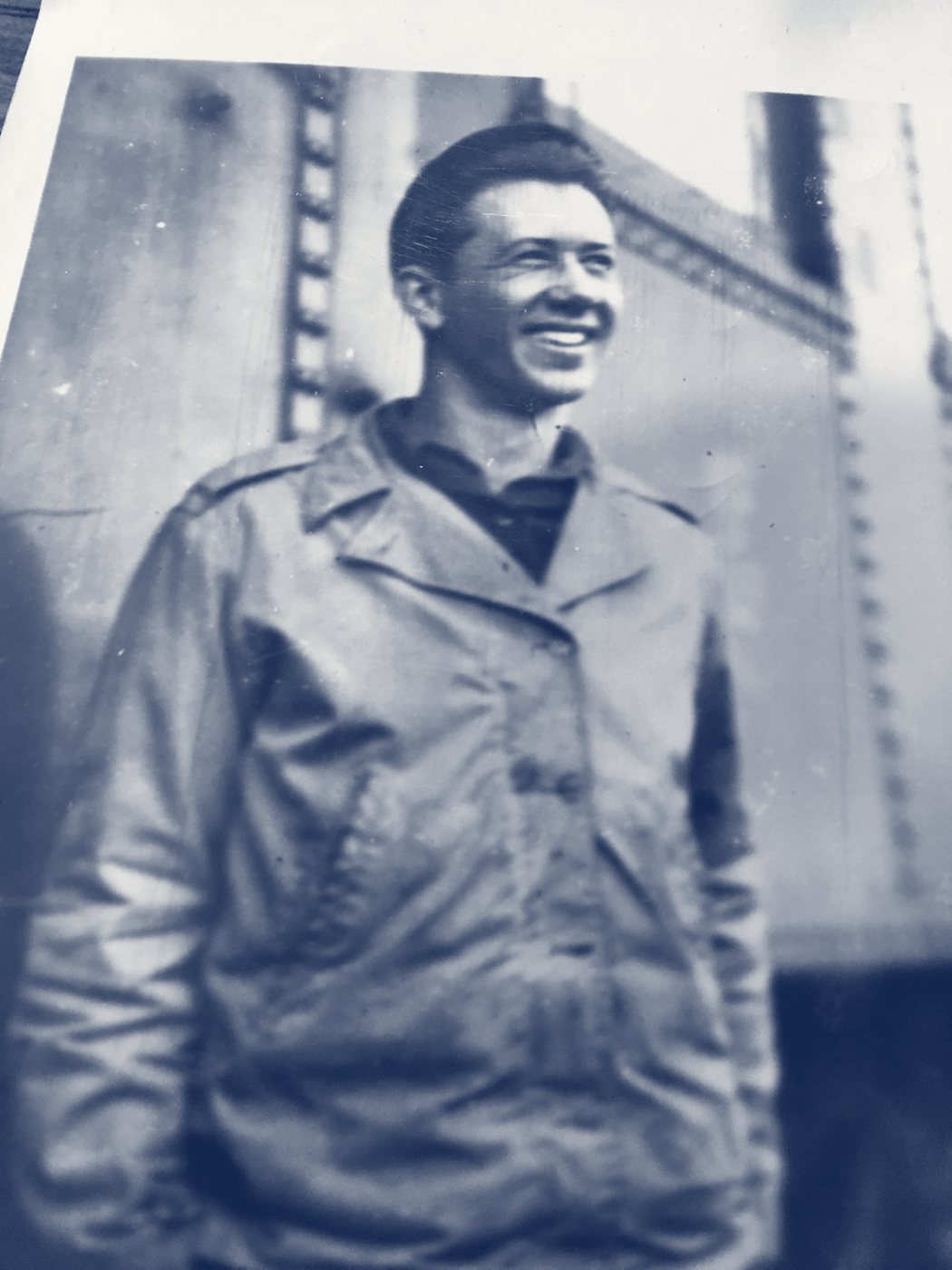
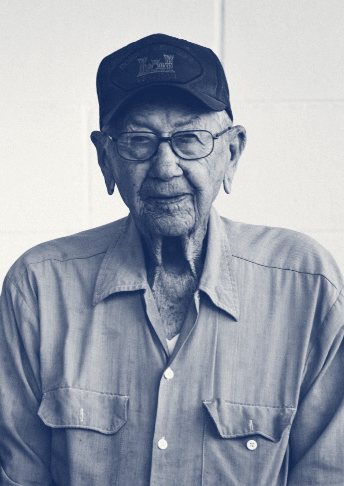
Papa was my grandfather, Frank Joe Valenta. He was born in 1921, and he lived to see 100. Before he passed, I sat down next to him in the living room of the ranch house, set my phone down between us, and pressed record. I asked the questions, and he did the rest.
We laughed through most of it. Papa had a great sense of humor and a great memory, and once he got going, the stories just kept coming. An hour and six minutes into that first session, after he’d taken me all the way from Texas to the Rhine, he turned around and asked me a question of his own.
Who’s gonna get that into a story?
PAPA, TO ME
I told him I would. I didn’t realize then how much those recordings would come to mean to me. Some days now I put one on just to hear his voice telling me these stories again. This is me keeping that promise.
What follows is his war, as much as I could manage it, in his own words. He was reaching back more than seventy years, and he got nearly all of it right. Where his memory and the Army’s record part ways, you’ll see a small number, and the notes are at the end.
Help the boys out
Papa grew up in Schwertner, Texas, in his father’s garage. It was the Model T era, and the only toys the Valenta kids had were the old tires that came off the cars in his dad’s shop. He never went to high school. By the time he was a teenager he could weld just about anything, and by 1940 he was working as a mechanic in a shop in the next town over, three dollars a day, six days a week. He saved up $165 and bought himself a 1936 Ford.
Then came Pearl Harbor.
Everybody, I mean, they were worse than a damn stampede. They were all going to the training camps.
Papa was 20, and the draft hadn’t reached him yet.1 He wasn’t going to wait for it, either. A man who got drafted went wherever the Army needed him, but a man who volunteered got a say. And somewhere in all the talk, he’d heard a word that stuck with him: engineers.
I said, I’m good with a rifle, and I’m damn good with welding, and I’m damn good on them Model T Fords.
He told his father he wanted to go help the boys out, and his father told him it was up to him. The draft board said that if he wanted to volunteer for the Corps of Engineers, he’d need to come back with three letters of recommendation. His father signed one, and the men who owned the shops where he’d worked signed the other two. Then he rode the train all night and stepped off at Fort Sam Houston, in San Antonio.
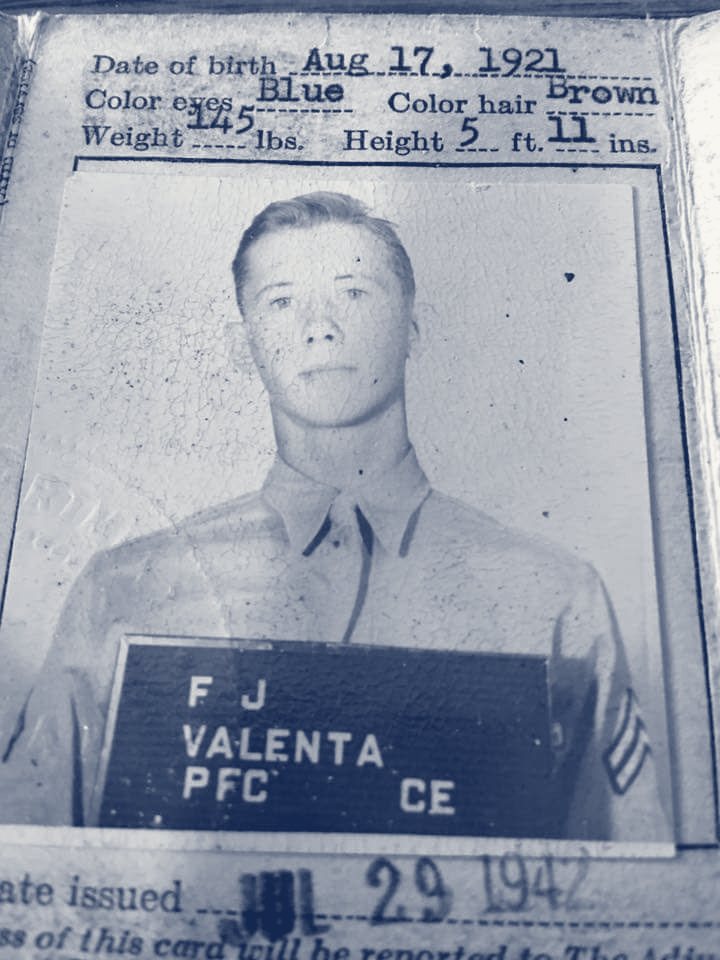
The Army put him through a round of tests on gears and engines, and before he’d even traded his own clothes for a uniform, he was a private first class. The pay took some getting used to.
When I got inducted, I was making $18 a week. When I joined the Army, it was $21 a month.2
The crossing
From San Antonio the Army sent him to Camp Claiborne, Louisiana, where a brand-new regiment was taking shape: the 347th Engineers, activated on May 6, 1942. Its men were bulldozer and crane operators, welders, mechanics, tractor drivers, and surveyors, and Papa figured he was the youngest of the bunch.
We were kind of a selected group. We didn’t end up on KP or do any kind of latrine work or nothing.
In July 1942 they got word they were going overseas. They shipped out of New York at night, by way of Camp Kilmer, New Jersey, and Papa never did get a look at the Statue of Liberty. The rumor on board was that they were headed north to build the Alaska Highway, and it wasn’t a crazy rumor. That same year, Army engineer regiments like the 340th were cutting that highway through Canada.
Instead the ship kept close to the northern shores, away from the U-boats, zigzagging every three minutes and running without a single light at night. The crossing took eighteen days. At some point, somebody decided Papa should be the ship’s MP.
At night, no lights. And all my job was to see that the gunner in the front and the gunner in the back is staying by his gun. That’s all I had to do.
Some mornings he’d look out and the convoy was all around them. Other mornings there was nobody out there at all. They anchored off Iceland for a night or two, he remembered, and on August 17, 1942, somewhere out on that ocean, Papa turned 21. That August they landed at Liverpool.3
Well, it ended up, we hitchhiked. Nobody knew where that ship was going.
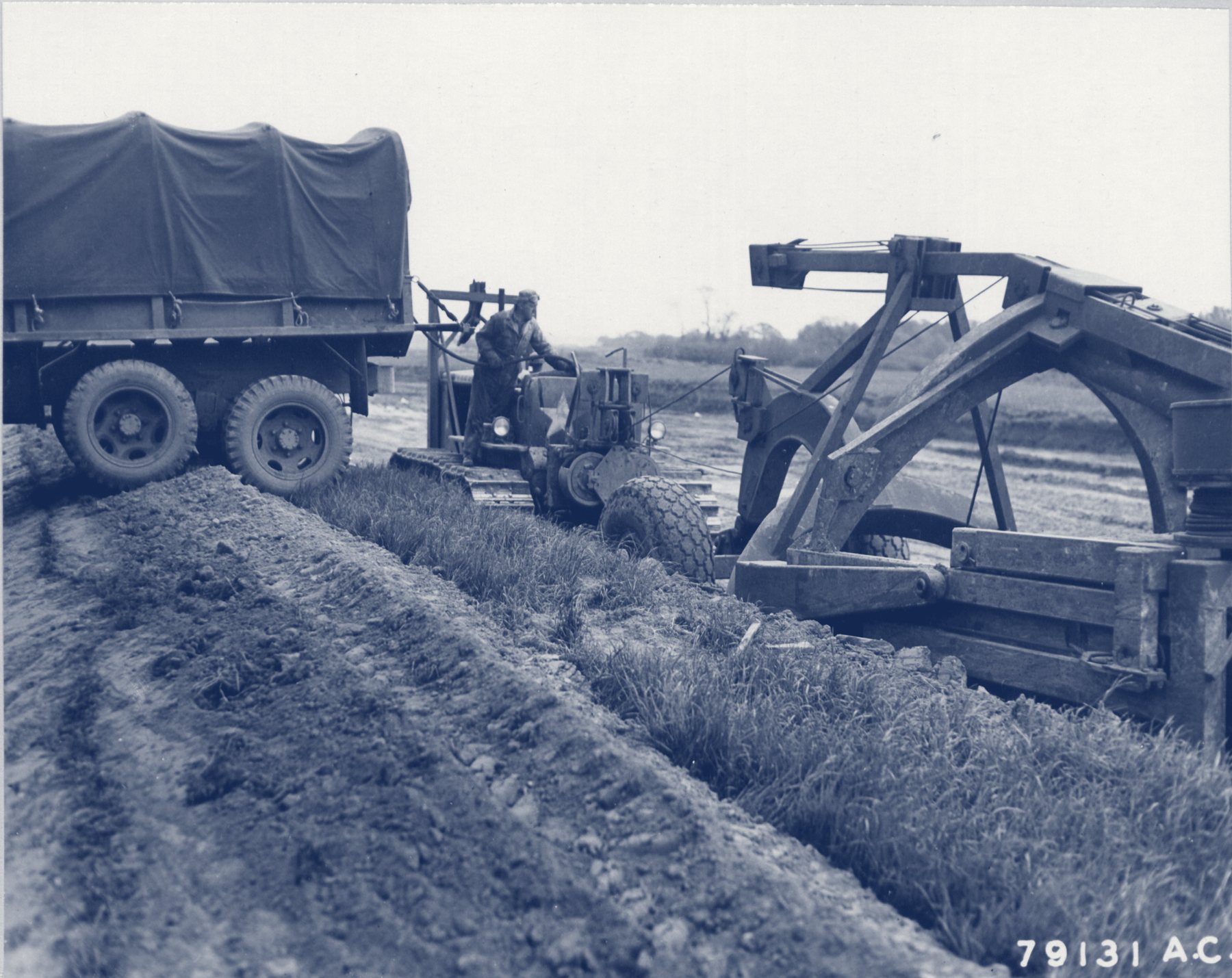
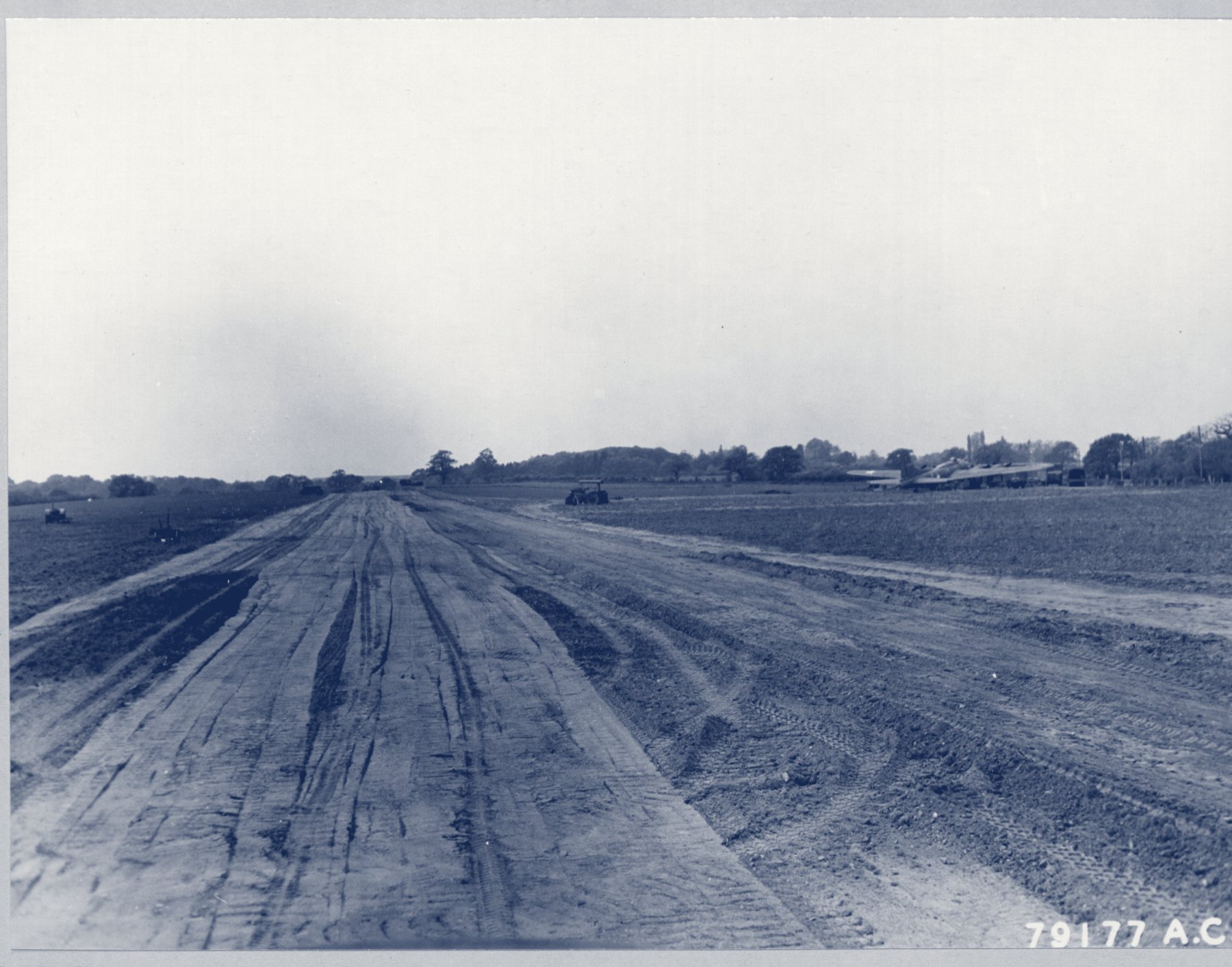
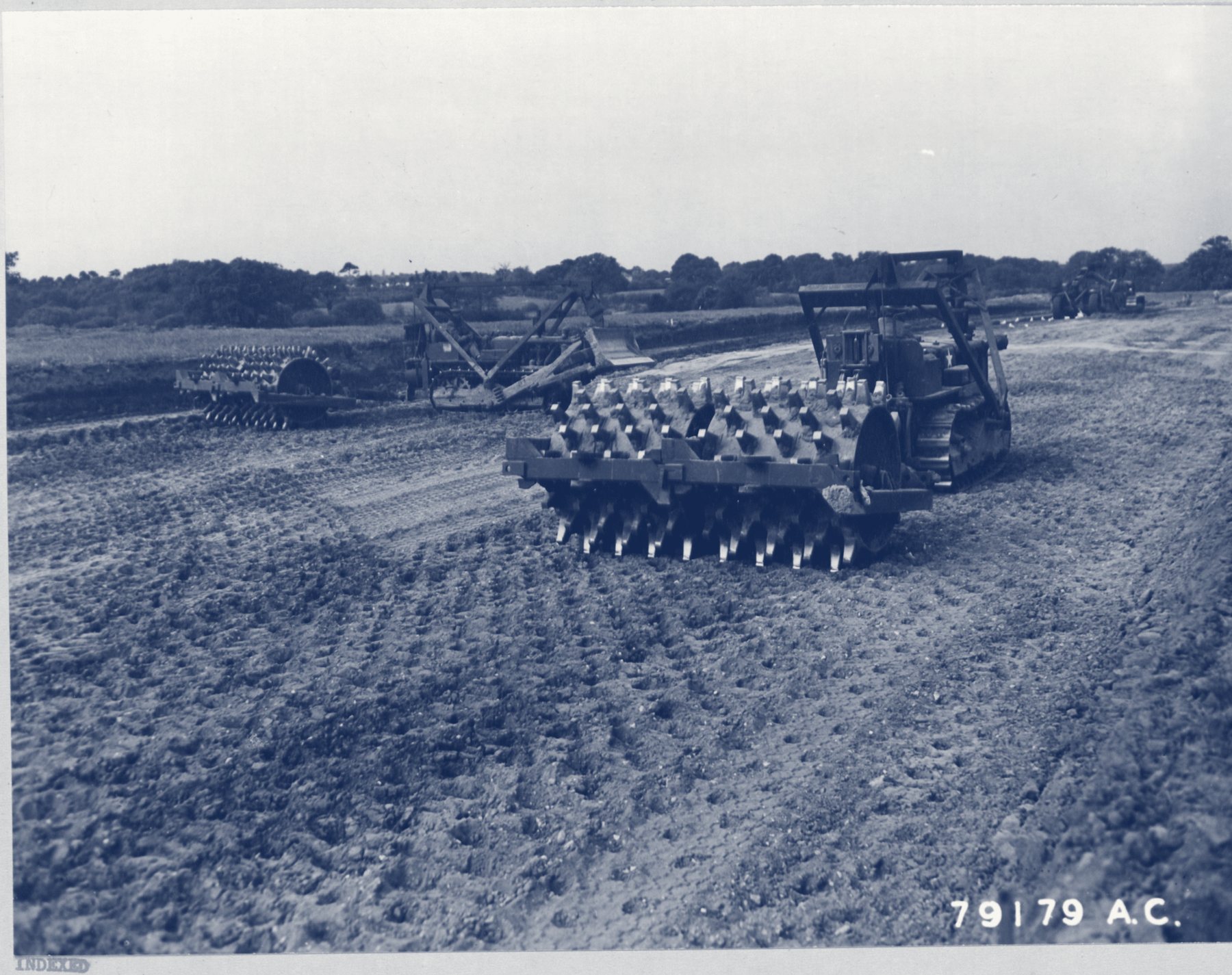
The regiment came to be known as Hulen’s Hitchhikers, after its commander, Colonel Harry Hulen, and England was home for the next two years. The 347th built runways for the air forces, camps and quarters for every branch of the service, and cleaned up after the bombing raids.4
The motor pool
Papa was in Headquarters and Service Company, “with the brass,” as he put it. On one of his first days, a lieutenant read his record, saw “mechanic” and “welder,” and handed him a toolbox and a jeep. Two flatcars of American tractors had just come into a British rail yard, and his orders were to get every one of them running and report back.
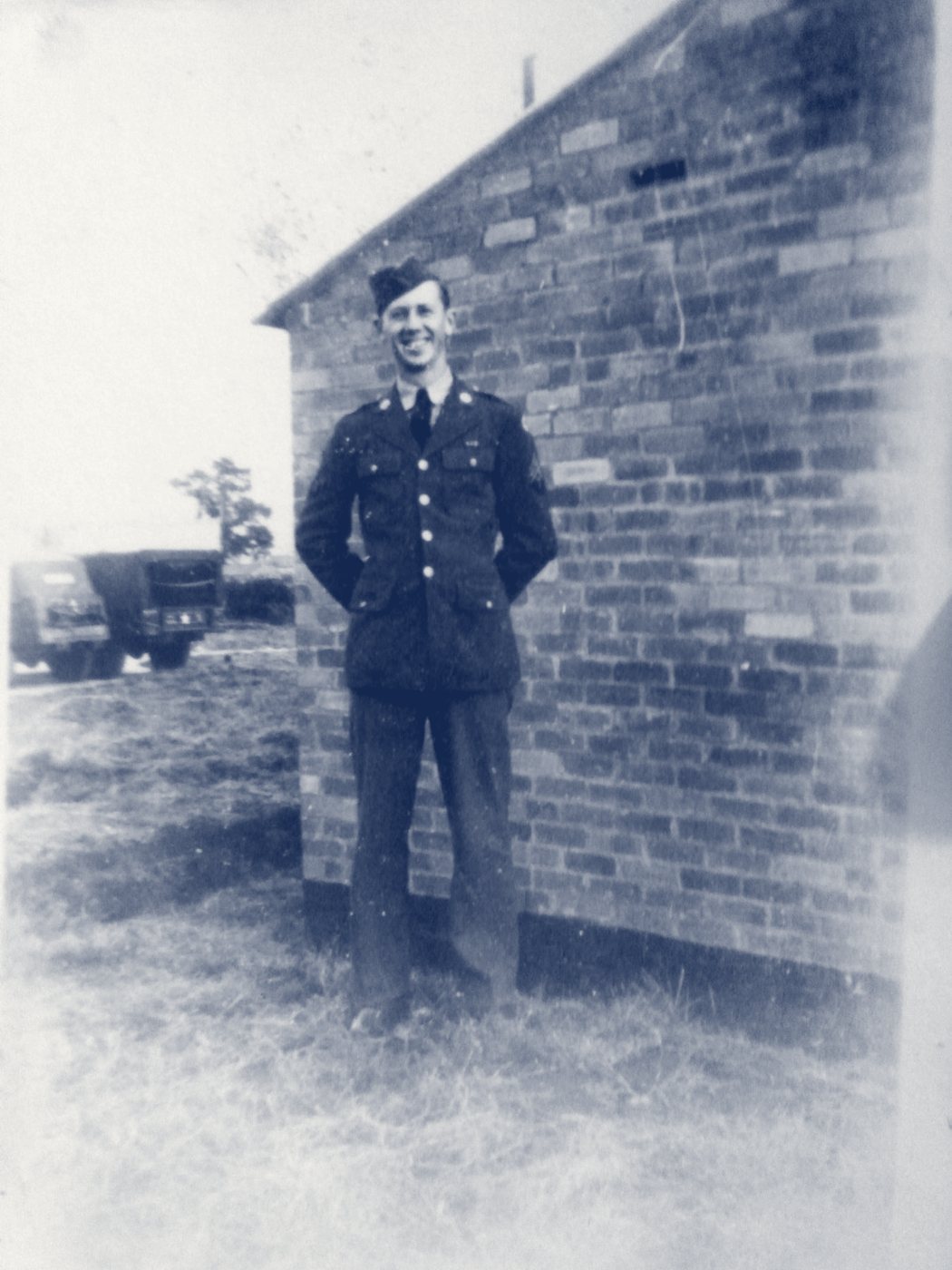
Heck, in about an hour and a half, everything was brand new. I had them all running.
A week or two later, the boys in his tent told him his name was up on the board. He went to look. He’d been made a sergeant and put in charge of the motor pool: every jeep, truck, and motorcycle in the outfit, and the shop that kept them all running.
One morning a master sergeant sent him over to the shop, where a sheet of inch-thick steel plate was waiting with shapes scribed on it. Papa cut them out with the torch and walked back to his tent, and nobody told him what they were for. He found out later. The Army didn’t have railroad bridges of its own design yet, so it built British ones, steel spans in standard lengths that a crane could set down across the gap where a bridge used to be. The 347th was one of only two American regiments trained at the U.S.-British Railway Bridging School at King’s Newton, in Derbyshire.
So that’s where I found out what I’m doing.
Not long after that, a new lieutenant showed up. He was 19 years old, fresh out of officer school, with a .45 strapped to his hip, and he walked into the motor pool and announced that he was in charge of it. Before long, one of Papa’s mechanics pulled him aside and told him he’d better do something. So Papa put the lieutenant in a jeep and drove him out of camp for a little talk.
I said, Lieutenant, I want to teach you something. You need to know before you get hurt. Them guys have been mechanicin’ 20 years, 30 years. Why don’t you just listen a while? He said, yeah, but remember, I’ve got that .45. I said, yeah, I can see it. I don’t even know if you got a shell in it. But anyway, we want to teach you how to get along with people, and not your rank. That don’t go.
Papa lost track of him for a while after that. Then the lieutenant turned up again, and he stayed right there with Papa all through France and Germany.
The colonel had a problem of his own. The English didn’t quite know what to make of all these Americans, and he wanted something to lift everybody’s spirits. Someone noticed on Papa’s record that he could play the clarinet, and that’s how he ended up in the colonel’s band. They called themselves the Hitchhikers. They played dances for fighter pilots and nurses as part of a USO troupe, and in London they played for widows and for the children in the orphanages.
The fighter pilots were so damn happy, because they didn’t know if they were coming back tomorrow.
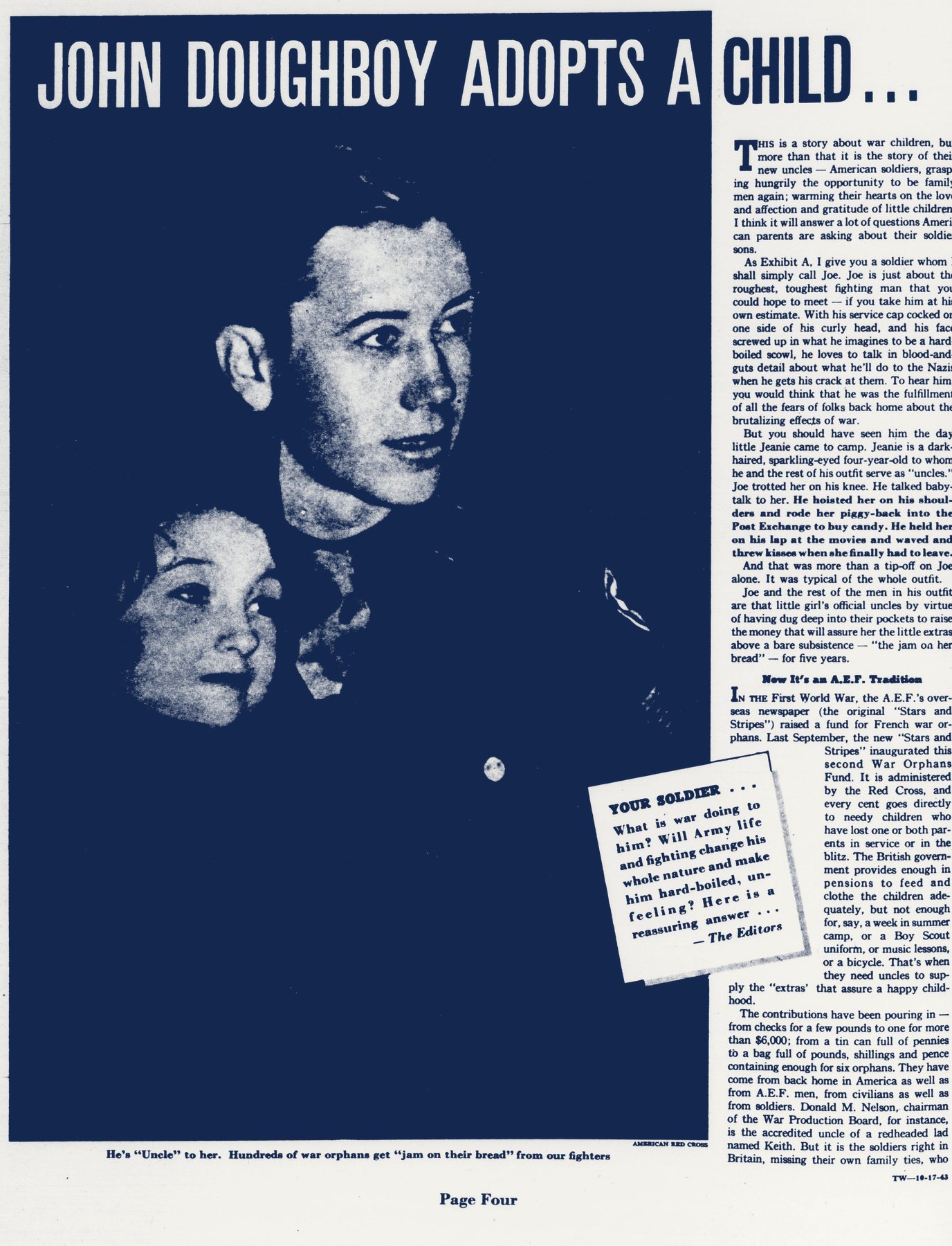
In their time off, Papa and a few of the other men gave their own money and their own time to the English war orphans near camp. The Stars and Stripes ran a War Orphans Fund for British children, and the Red Cross looked after the money. Somewhere along the way, a photographer caught Papa holding a little girl. On October 17, 1943, that picture filled a whole page of This Week, the Sunday magazine that came tucked inside newspapers all across the country, under the headline “John Doughboy Adopts a Child.” Our family still has that page.
Omaha
Before they crossed, everybody got a haircut: one inch, or nothing at all, and most of them went with nothing. There were a thousand of them waiting in the dark at the staging area when somebody tapped Papa on the shoulder. He was going to drive the colonel.
He spent that night alone behind the wheel of a command car down in the belly of a landing craft, with a case of C rations on the back seat. Around four or five in the morning, the colonel came down and climbed in the back without saying a word. At first light they started across the Channel.
It was the last days of June, a few weeks after D-Day.5 They came in right behind the great storm of June 19 to 22, which battered the Normandy coast and tore apart the artificial harbor the Allies had built off Omaha Beach.6
The ramp dropped short of the beach. A jeep with two GIs in it went off first, floated for a moment on an air pocket, and sat right in his way. Papa jumped out to get past it, and it sank. Then he drove the command car off the ramp into three or four feet of water and wove it through the wreckage to the sand.
He got out of that thing wet, C rations floating on the back seat. He says, Sergeant, damn you. I thought you’d never make it to that shore.
The map reader in the back seat gave him his directions: take a right, cross a bridge, climb the hill, and turn left at the old building.
Yes, sir, that’s all I need to know.
At the bridge an MP flagged him down. The Germans were shelling it, and the MP told him he could cross at his own risk.
I said, well, that’s all I need. When that first shell hit, I told the colonel, just hang on. I took off, and I no more got on that bridge, that second shell came in. And it just soaked us. And I drove through it.
On the far side they drove too long. Papa slowed down and spotted a soldier in a ditch with grass stuck in his helmet, and he asked him where in the world they were.
He said, about two more hundred yards and you’ll be in the crosshairs. I said, that’s all I need. I threw that thing in reverse, and God, I guess I went from here to hell.
We laughed a lot in those sessions, and the shellfire story always got us. Looking back on it now, I can hear what was underneath all that laughing. It was bravery and courage, the kind that lets a 22-year-old drive onto a bridge under fire because it’s the job, without asking for anything more than directions. The only name I have for it is selfless service.
Patton’s railroad
We built that rail. Patton had us to be his supply for the Third Army by rail. So yeah, that was our job.
And that’s exactly what the 347th did. The Army’s official history calls it “the general service regiment most experienced in railroad work.” In July the regiment rebuilt the rail yards at Cherbourg. Then on July 25, the bombers came over Saint-Lô to open the breakout, and Papa never forgot it.
They sent out maybe 150 bombers. I’ve heard stories that they could be up to 500 bombers. And if there was a city in the way, they just take the city out.7
On August 4, two companies of the 347th went to work on the Saint-Lô rail yards, which the bombing had all but wiped out. Then, after sunset on August 12, a message came down from Third Army:
Gen Patton has broken through and is striking rapidly for Paris. He says his men can get along without food, but his tanks and trucks won’t run without gas. Therefore the railroad must be constructed into Le Mans by Tuesday midnight. Today is Saturday.
THIRD ARMY TO THE ADSEC ENGINEER, 12 AUGUST 1944
Tuesday midnight meant 135 miles of railroad, with seven bridges down, in about 75 hours. At Saint-Hilaire-du-Harcouët the Germans had blown the bridge over the Sélune River, and the 347th rebuilt it in three days, “during which many of the men had no sleep at all.” The first gasoline train pulled out of Folligny at seven in the evening on August 15, crossed that bridge a little before midnight, and rolled into Le Mans on August 17. Thirty more trains followed it.
In September, at Juvisy, just south of Paris, the 347th put four prefabricated bridge spans together on the riverbank and floated them out into the Seine on a French derrick barge. They finished two days early. Until that bridge was in, the official history says, Third Army couldn’t be supplied east of Metz.
Papa admired Patton.
He was a fighter. That’s what we liked about him.
Somewhere in there, the motor pool sergeant found himself a reason to ride a Harley-Davidson into Paris. He still had the MP badge from the ship, so when the MPs in Paris asked where he thought he was going, he told them he had a truck somewhere in the city and needed to go find it. Then he rode right past the Eiffel Tower, Notre Dame, and the Arc de Triomphe.
At his 100th birthday, somebody asked him whether he ever found that truck.
Never been. It’s still out there somewhere.
Not everything the Germans left behind was harmless.
The Germans would put on pretty silk ribbons, and there’d be a hand grenade on the end of it. And if the French, or whoever, the German kids, or the American soldiers, if they jerked it, there goes a damn hand grenade.
They’d hide the ribbons in the brush. And when the Germans pulled out of a house, Papa said, sometimes they’d leave a grenade in the stove for whoever lit the next fire.
That December the Germans made one last push, through the Ardennes in Belgium, and Papa remembered the regiment being moved north.
We were all moved to the Brussels area. But anyway, they didn’t give us a gun.
He remembered a town the Germans had surrounded, and a German officer who walked out under a white flag to ask the American general to surrender and save some lives.
He told them to hell with it.
The town was Bastogne.8 On December 22, the general there, Anthony McAuliffe, answered the German surrender demand with a single word: “Nuts!” Papa’s version was close enough. Patton’s Third Army broke through to Bastogne on December 26.
They had us sitting in ditches and anywhere with no guns. But if they needed us, they could drop the guns to them, and we would be in there fighting with them.
I asked him if that was as close as he ever got to the front line.
Oh, God. Two, three miles, four miles. That’s the closest.9
Nine and a half days
By the spring of 1945 they’d made it to the Rhine at Mainz, and the bridge was down.
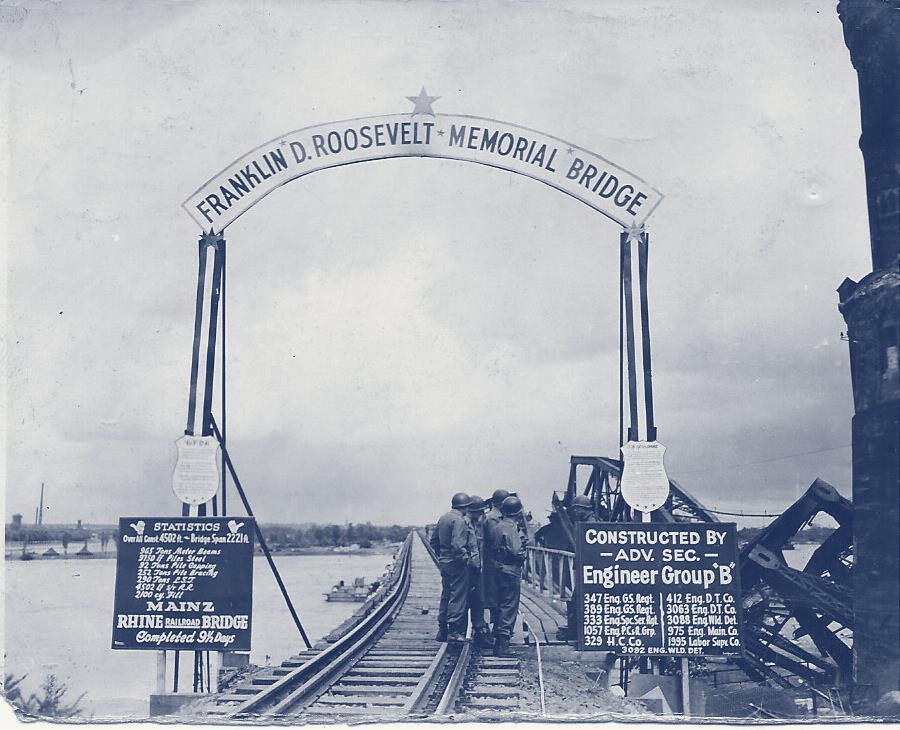
Patton gave us two weeks to build it. They were in Frankfurt and we were in Mainz, and we met in the middle of the river. And it took us nine and a half days to build it.10
Patton wanted his railroad across the Rhine. The Germans had blown the old railway bridge between Mainz and Gustavsburg in March. Since the summer before, the 347th’s colonel, Harry Hulen, had also been in charge of Engineer Group B, with the 347th as its headquarters regiment, which is what Papa meant when he said they were the headquarters of all them engineers. Group B opened a single track from Thionville to Mainz on April 1, and on April 4 it started on the bridge.
Nine and a half days, Papa said. The engineers who built it said the same thing on the sign they put up at the bridge: “Completed 9½ Days.”11
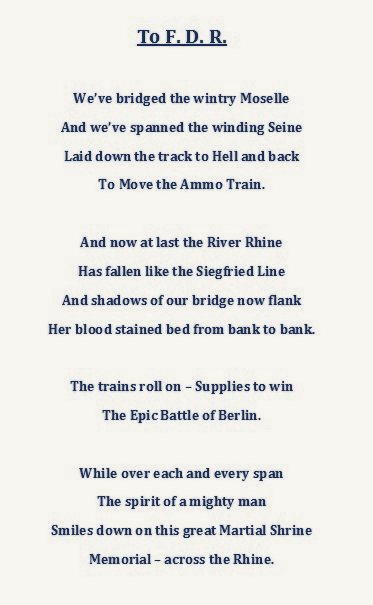
President Roosevelt died on April 12. Two days later, on April 14, 1945, they dedicated the bridge and named it for him: the Franklin D. Roosevelt Memorial Bridge. It was the second American railroad bridge across the Rhine, and it carried supplies over the river through the last weeks of the war in Europe.
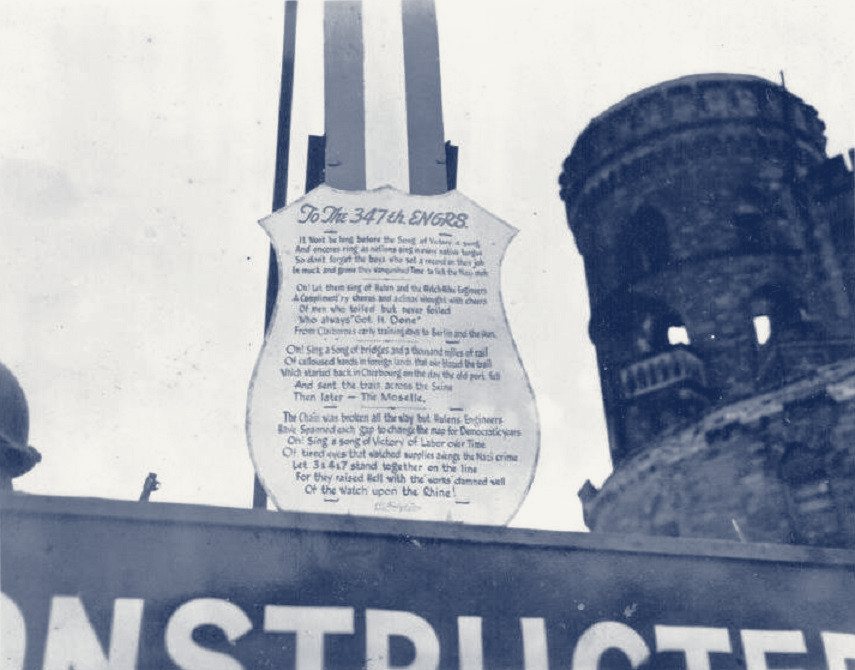
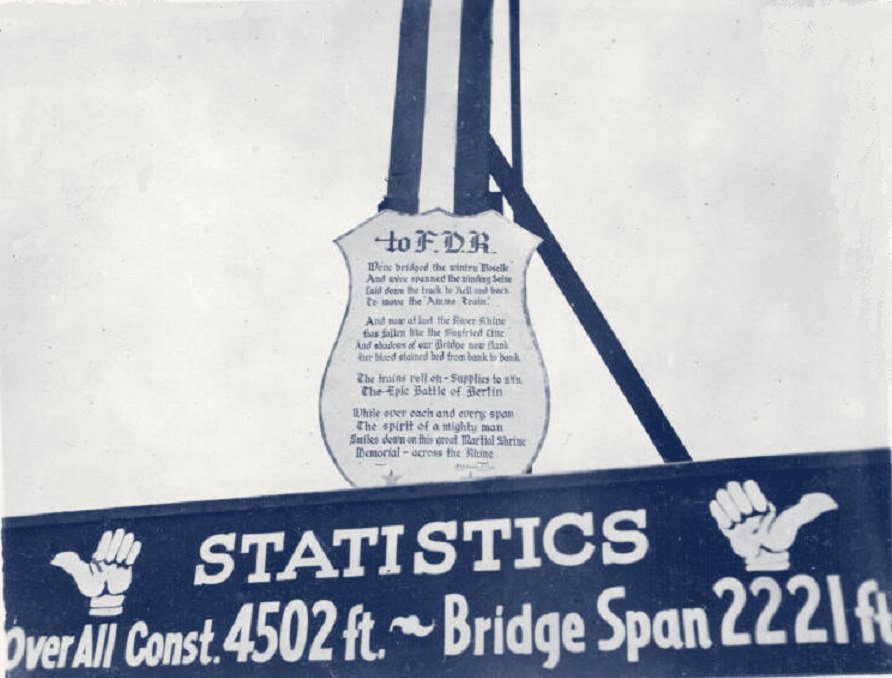
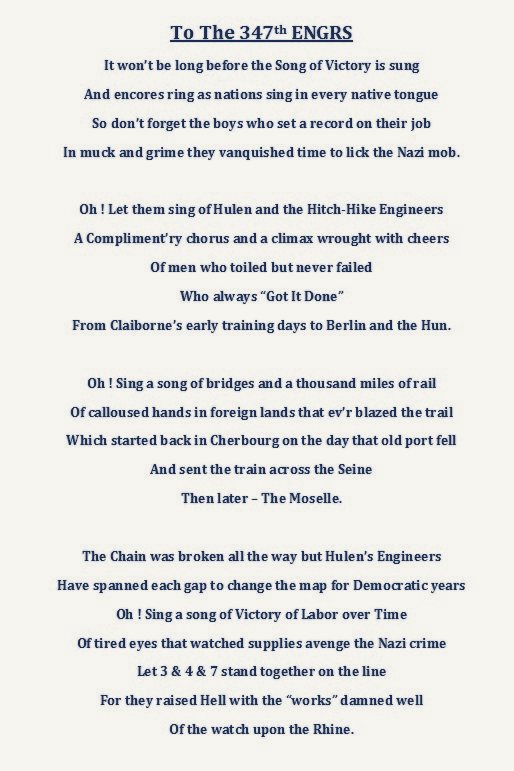
The poem to the regiment explains the nickname: “Oh! Let them sing of Hulen and the Hitch-Hike Engineers.”
First gear
One morning Papa walked out of his tent and found a Corbitt tractor-trailer sitting there with a crane on the back. He’d never seen an 18-wheeler in his life. Somebody told him he was driving it to the next bridge job, and that if night came, he was to shut off the engine and stay with it, because of the flares.
He lifted the hood, saw the air compressor, and figured at least it had brakes. He drove it through pastures and brush at a walking pace while the crane operator, a man named Don, rode up top and swung the boom clear of the wires and houses in the villages. When German boys jumped on the trailer, Don, who spoke German, kicked them right back off. Years after the war, Don went looking for Papa.
As far as I know, I never shifted it. First gear. But I got it to wherever I was going. That’s all I know.
Home
Papa came home a Technician Fourth Grade, paid as a sergeant, and was discharged in October 1945. He wore the European-African-Middle Eastern Campaign ribbon with four bronze battle stars (Normandy, Northern France, the Rhineland, and Central Europe), the Good Conduct Medal, the Sharpshooter Badge, and six overseas service bars, one for each six months abroad.
He married Lorine Zurovetz in 1949. In 1959 he left his job as shop foreman at a car dealership and opened his own garage. Sixty-two years later it was still in business, because of his name for honest and dependable work. More than once he got somebody back on the road at his own expense.
After Lorine died, he set one last goal: to reach 100. He passed it by 79 days.
That’s all I need to know
Listen to those recordings long enough and you start to hear one sentence over and over. The colonel’s map reader tells him which way to turn. The MP warns him the bridge is under fire. A stranger in a ditch tells him he’s two hundred yards from the enemy. And every time, Papa gives the same answer.
That’s all I need to know.
He never needed the whole picture. He needed the job, and then he did it.
He told me once that somewhere overseas, after seeing what one man can do to another, he made himself a promise right then and there. From then on, he’d treat people the way he wanted to be treated. He’d see the world through happiness and joy, look for the good in people, and never forget to laugh. Anybody who knew him can tell you he kept it.
Some days I’d pull up to the ranch and find him sitting out on the porch, just enjoying the day and the peace and quiet. Most of what I understand about this world, I learned sitting next to him.
A Long Horizon
Occasional letters on building companies meant to last, legacy, AI and the new world, and lessons from the people who taught me.
Notes
- Papa remembered being 19. He was born on August 17, 1921, so he was 20. When Pearl Harbor was bombed, a man had to be 21 to be drafted. On December 20, 1941, Congress lowered that to 20. His “they just missed me by six months” was him counting toward his 21st birthday. ↩
- A private’s base pay was $21 a month until June 1942, when Congress raised it to $50. ↩
- Iceland and Liverpool are as Papa remembered them. The record doesn’t name his ship or his port. Most of the big troop convoys in 1942 ended in Scotland, on the Clyde, but some ships went on to other ports. ↩
- The Army’s history of its engineers also places the 347th at the engineer supply depots in England. ↩
- Papa remembered landing about two weeks after D-Day. The Army’s history of its engineers puts the 347th on the Continent about June 28, and the regiment’s honors record says June 29. ↩
- The record doesn’t say which beach the 347th came in on. Papa said Omaha. ↩
- The Army’s history counts more than 1,500 American heavy bombers over Saint-Lô on July 25, 1944. ↩
- Papa remembered the surrounded town as Brussels. The Germans had held Brussels from 1940 until September 1944, but they never got it back in the Bulge. His memory of being moved toward Brussels fits the family record that his service took him into Belgium and Luxembourg. ↩
- The 347th earned no battle star for the Ardennes, which fits what Papa remembered: close to the fighting, but behind the line. ↩
- The record doesn’t say what deadline the engineers were given. The bridge ran from Mainz to Gustavsburg, on the far bank, which is the Frankfurt side of the river. ↩
- One official history, Ruppenthal’s Logistical Support of the Armies, says ten days. The Twelfth Army Group’s engineer report says nine and a half, like the sign. ↩
How I treated Papa’s words
Every quote is Papa’s, from my recordings, trimmed for length. I kept his grammar. I only fixed words the transcription software misheard: “Ford Slam” is Fort Sam Houston, “sea rations” is C rations, “Mayans” is Mainz, “Corbett” is Corbitt, “Norderdom” is Notre Dame, and “marked the triumph” is the Arc de Triomphe.
Sources
- Papa’s words: my interviews with Papa (part 1, part 3, and his 100th birthday).
- Unit and railroad work: Beck, Bortz, Lynch, Mayo, and Weld, The Corps of Engineers: The War Against Germany (U.S. Army Center of Military History, 1985), pp. 272, 397 to 405.
- Papa’s dates, crossing, England, band, orphans, medals, and life after the war: his obituary, written by our family (Scanio-Harper Funeral Home, November 2021), and KCEN-TV, “Family honors 98-year-old veteran of WWII” (November 14, 2019).
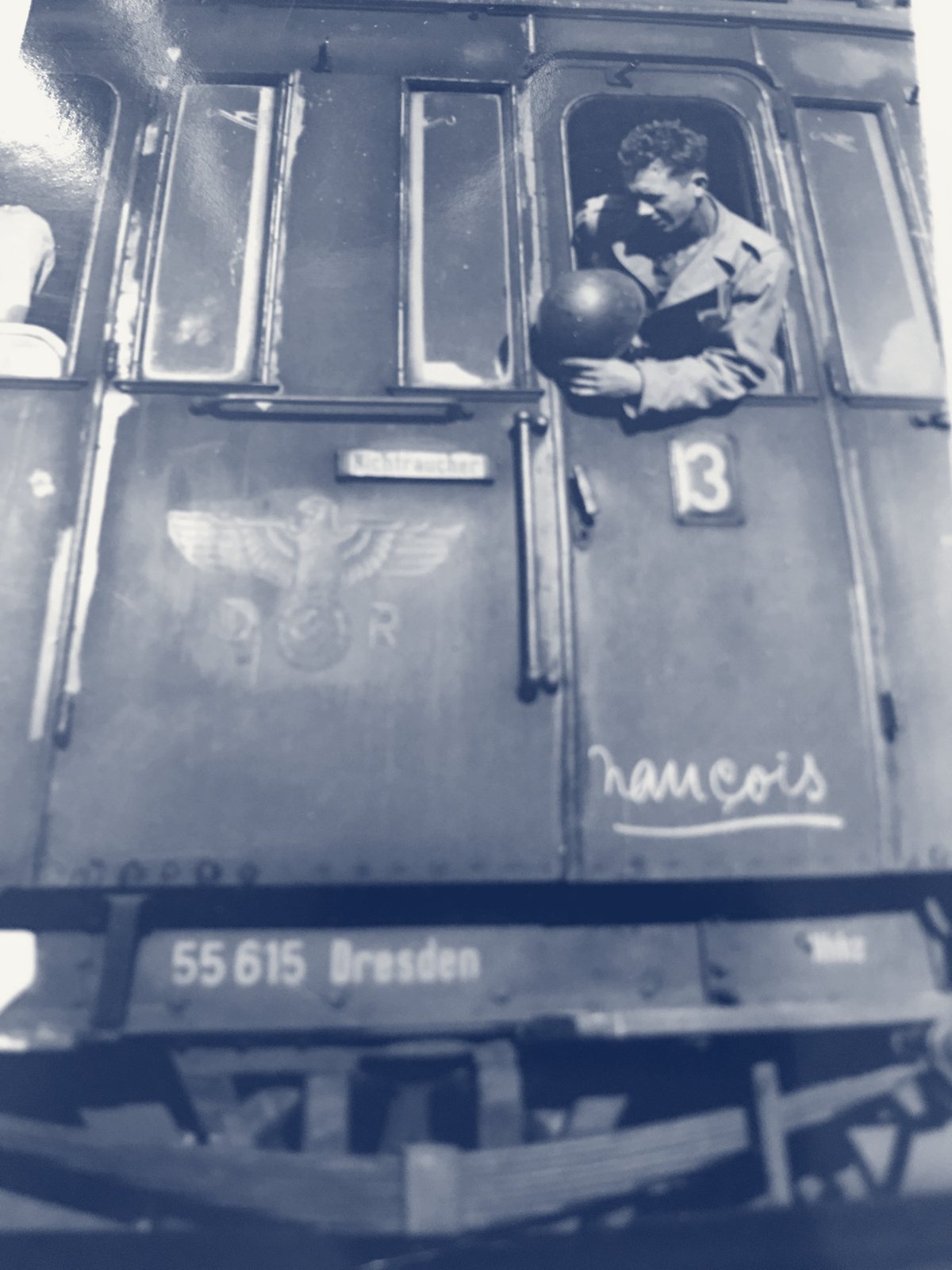
- Photos: his ID card and the photos of him in uniform, in his field jacket, and at the Dresden railcar are family photos. The runway photos are U.S. Air Force photos at the National Archives (NAID 204880830 and related). The magazine page is This Week, October 17, 1943, page 4, from the Library of Congress. The bridge photos and the typed poems were posted online in 2015 by the son of a 347th veteran. All photos are shown in the site’s ink and paper colors.
- Draft ages: the Selective Training and Service Act of 1940, amended December 20, 1941.
- Unit dates and honors: Center of Military History, Lineage and Honors, 18th Engineer Brigade (formerly the 347th Engineers).
- Mainz bridge: Ruppenthal, Logistical Support of the Armies, Vol. II (CMH, 1959), p. 410, and P. H. Timothy, The Rhine Crossing: Twelfth Army Group Engineer Operations, as cited by Wikipedia.
- Operation Cobra: Blumenson, Breakout and Pursuit (CMH, 1961), chapter XII.
- Bastogne: Cole, The Ardennes: Battle of the Bulge (CMH, 1965), and army.mil.
- The storm: Naval History and Heritage Command, “The Storm of 19 to 20 June 1944: The End of Mulberry A.”
- Alaska Highway: ExploreNorth and the 340th Engineer Regiment unit history at the Army Heritage and Education Center.
- Maps: coastlines and rivers from Natural Earth (public domain). Routes are approximate. Country borders are drawn as of 1937, the lines the Allies recognized during the war. In this region they match today’s borders, except Germany’s eastern border, which moved west in 1945 and is not drawn. During the war Germany had annexed Luxembourg, Alsace and Moselle in France, and Eupen-Malmedy in Belgium. The maps show those places in the countries they belonged to before and after the war.